AP Business with Personal Finance

Business Canvas Dashboard

Checking account…

Your yearlong entrepreneurial record

Build a business idea you can explain, defend, and improve with evidence.

Your canvas is not a one-time worksheet. It is a living record of your best current thinking—updated as you research customers, test assumptions, make decisions, and learn what works.

0%

Canvas completion

Completion is not mastery. Strong work shows evidence, decisions, and revision.
01

Business wording

What are we accomplishing?

You are developing and evaluating an entrepreneurial opportunity. Across the course, you will assess the product's desirability, viability, and feasibility by testing hypotheses, interpreting evidence, and making strategic decisions.

DesirableDo customers want it?ViableCan it support itself financially?FeasibleCan it realistically be produced and delivered?
02

Explain it simply

What does that mean?

You are building a business idea, checking whether people actually need it, figuring out whether it can work, and changing your plan when the evidence tells you to.

ThinkTestLearnRevise

Student reference tools

Use these guides whenever you get stuck

They are not assignments. They are step-by-step references for analyzing cases and documenting strong hypothesis tests.

Case Study Guide

Read for decisions, evidence, and business meaning

Use a repeatable process to identify the central challenge, code evidence, write claim–evidence–reasoning responses, and transfer the lesson to another business.

Hypothesis Testing Guide

Turn assumptions into evidence-based decisions

Use examples, research-method guidance, quality checks, and a reusable testing template whenever a canvas deliverable includes an asterisk.

Course timeline

One project, developed across four units

The goal is not to finish early. The goal is to improve the quality of your thinking as your business knowledge grows.

Living document
1

Unit 1 · Explore

Opportunity and foundation

Validate a customer problem, develop a solution, establish mission and vision, examine the market, and map the supply chain.

Suggested checkpoint: Week 8
2

Unit 2 · Test

Customer, product, and marketing

Build a target customer profile, test preferences, create an MVP and brand, choose pricing and channels, and analyze competitors.

Suggested checkpoint: Week 15
3

Unit 3 · Prove

Financial viability

Estimate startup costs, identify capital, project revenue, prepare an income statement, and develop the pitch.

Suggested checkpoint: Week 22
4

Unit 4 · Decide

Strategy and final revision

Create KPIs, assess skills, use PACED and strategic frameworks, and revise the entire canvas into your strongest final version.

Suggested checkpoint: Week 28

Why this matters on the AP Exam

You must be able to discuss the process—not merely show a finished idea.

Your score does not depend on having the most profitable or impressive business. It depends on how clearly you demonstrate course skills and explain the reasoning behind your work.

Exam-DayCanvas Validation FRQ
01

Name the hypothesis

State the specific prediction or assumption you tested.

02

Describe the method

Explain the primary- or secondary-source research used.

03

Use actual evidence

Reference a result, pattern, quotation, behavior, number, or finding.

04

Explain the decision

Show how the evidence changed, confirmed, or refined your business.

05

Transfer the thinking

Apply the same concepts and reasoning to unfamiliar business situations and cases.

Master Canvas

Your current business at a glance

Appendix: Data visualization · Pitch · Actual or projected income statement

Living project

My Business Canvas

Click any colored section to add, revise, and support your best current thinking. Every save creates a new checkpoint in your yearlong process.

Canvas target0 wordsFinal canvas may contain up to 1,000 words.
Appendix elementsData visualizationPitchActual or projected income statement

Reference hub

Business Canvas 101

Use this page whenever you need to remember what belongs in each section, why it matters, or which unit adds each deliverable.

Big idea:

The canvas is a connected system. A change to your customer, product, price, or supply chain may require revisions in several other sections.

At-a-glance template

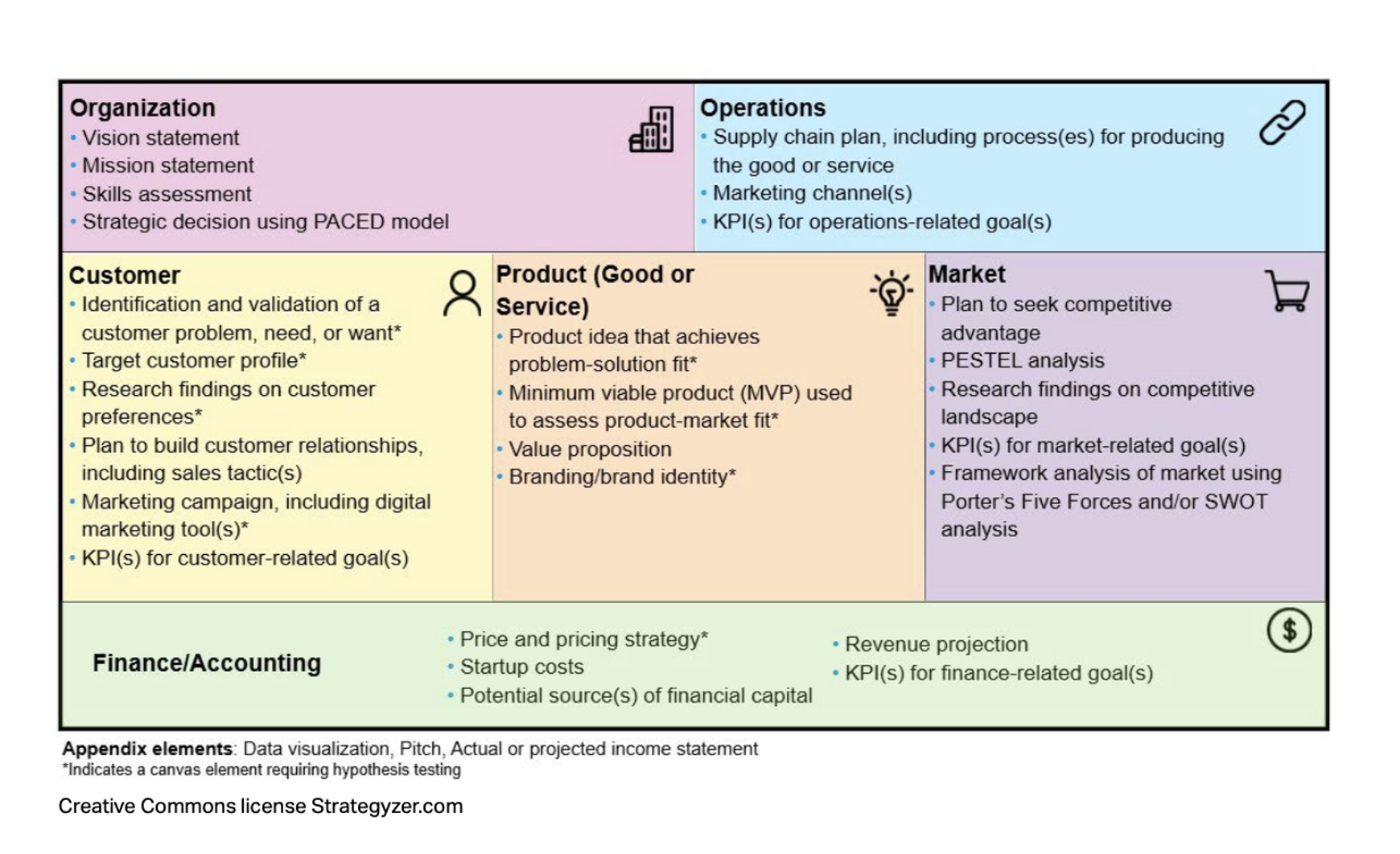
The complete Business Canvas

Asterisks identify elements that require hypothesis testing.

Business Canvas template showing Organization, Operations, Customer, Product, Market, Finance and Accounting, and appendix elements

Click to learn

What belongs in every section

Deliverables by unit

What is added—and when

Each unit adds new evidence and decisions to the same master canvas.

Introduction and yearlong reference

Case Study Guide

A business case is a decision environment—not a passage to summarize. Use this guide to find the central issue, select relevant evidence, apply business concepts, and explain what the evidence means.

1 · Find the decision2 · Code evidence3 · Apply a concept4 · Explain reasoning5 · Transfer the lesson
Optional annotation reference:Use the printable AP Business Annotation Guide when your teacher assigns a paper copy or PDF. Digital highlighting and the Evidence Notebook remain optional unless specifically assigned.Download annotation guide
01

Read with purpose

Find the decision, not just the topic

Locate five anchors

  • Decision-maker: Who must act?
  • Opportunity or challenge: Why is action needed?
  • Goal: What outcome is the business seeking?
  • Constraints: What limits the choices?
  • Stakeholders: Who benefits, pays, works, supplies, invests, or experiences risk?
Bombas example

Heath and Goldberg were not simply deciding how to sell socks. They had to determine whether a premium everyday sock could create enough customer value to support profit and a one-for-one donation model.

Central business question: Can a differentiated product, mission, price, and target customer work together as a sustainable business?

02

Evidence coding

Separate facts, interpretations, and unsupported assumptions

Tag evidence by canvas component so you can see how the business system connects. A single detail may support more than one component, but your explanation should make the connection clear.

CustomerProductOrganizationOperationsMarketFinance
Fact from the case

Bombas raised $150,000 through crowdfunding in 30 days.

Reasonable interpretation

The result suggests early supporters saw value in the concept and mission.

Unsupported leap

Every customer would pay any price because the mission was popular.

Evidence quality check:

Prefer specific actions, numbers, research findings, stated goals, customer behavior, costs, constraints, and outcomes over broad descriptions.

03

Evidence-based writing

Use claim–evidence–reasoning

CClaim

Answer the question directly using accurate business terminology.

EEvidence

Use a specific fact, number, action, result, or quotation from the case.

RReasoning

Explain how the evidence supports the claim and why it matters to the business.

Weak

Bombas was successful because people liked the company.

Developing

Bombas differentiated itself with premium socks and a donation mission.

Strong

Bombas created customer value through product differentiation and a social mission. The founders spent more than two years researching and testing comfort features, while the one-for-one model appealed to customers who wanted to help others. Together, the evidence explains why target customers could view the $13–$20 price as more valuable than a basic sock.

Reliable sentence frame

[Business] achieved or faced [business outcome] because [specific evidence]. This demonstrates [business concept] because [reasoning].

04

Recommendation and transfer

Apply the principle—not the exact tactic

For a recommendation

  • State the recommended action.
  • Name the decision criterion: customer value, cost, risk, feasibility, competitive advantage, or another relevant factor.
  • Use evidence that directly relates to that criterion.
  • Acknowledge one trade-off or limitation when relevant.

For transfer

  • Identify the underlying business principle.
  • Explain what is similar in the new context.
  • Explain what is different.
  • Adjust the action to fit the new customer, market, resources, or constraints.
Transfer example

Bombas used repeated product testing to refine comfort features. A student developing a tutoring app should not copy the sock design process; the transferable principle is to test an MVP with target users before investing in a full product. The app team could test a clickable prototype and observe whether students can schedule a tutor without help.

05

Exam-ready habits

Avoid the most common case-analysis mistakes

Do not retell the whole case.

Select only the evidence needed for the prompt.

Do not treat an opinion as a fact.

Use cautious language such as “suggests” when making an inference.

Do not stop after a quotation.

Explain the concept and business consequence.

Do not ignore the task verb.

Describe, explain, evaluate, and recommend require different levels of reasoning.

Do not use vocabulary as decoration.

Name the concept only when you can accurately connect it to evidence.

Do not copy a tactic into every context.

Transfer the principle and adapt it to the new situation.

Completed canvas references

See how other students organized a full business idea

These examples use different formats and levels of detail. Study how they connect customer evidence, product decisions, market analysis, operations, and finance. Use them for structure and inspiration—not as text to copy.

5 examples
How to use these well:Choose one section you are currently building, compare two examples, and identify one organizational choice or evidence habit you can adapt to your own canvas.
Written canvas · DOCXFastFit

An AI-supported fitness and fashion app with detailed customer segmentation, survey evidence, MVP feedback, pricing, branding, and KPI development.

  • Specific demographic and psychographic profile
  • Numerical MVP and willingness-to-pay findings
  • Clear value proposition and brand choices
Written canvas · DOCXCloud Seat

A portable seat-cushion concept organized around a validated student comfort problem, focused competitive advantage, PESTEL factors, and measurable KPIs.

  • Concise problem-solution fit
  • Strong portability-based differentiation
  • Customer and market KPIs tied to goals
Presentation canvas · PPTXCooking Story

A visual business presentation for cultural cooking classes that connects the customer problem, service model, marketing, employee skills, operations, and financial assumptions.

  • Clear presentation hierarchy
  • Hypothesis and research connection
  • Integrated operations and finance slides
Presentation canvas · PPTXCloud Comfort

A polished presentation version of a student comfort product showing how the same canvas evidence can be communicated visually to an audience.

  • Evidence translated into presentation slides
  • Consistent branding and visual identity
  • KPIs grouped by canvas component
APSI model collection · DOCXBusiness Idea Collection

A multi-business reference collection with completed canvas components across service, food, mobile retail, subscription, and community-centered ideas.

  • Compare approaches across industries
  • See multiple value propositions and revenue models
  • Use as an idea-matching and discussion reference

Introduction and yearlong reference

Hypothesis Testing Guide

Entrepreneurs do not treat assumptions as facts. They identify what must be learned, state a testable belief, collect evidence, interpret the result honestly, and document how the finding shaped the next decision.

1LearnWhat must we know?
2HypothesizeWhat do we believe?
3TestHow will we collect evidence?
4InterpretWhat did we find?
5ActWhat changes next?
01

What are you trying to learn?

Start with decision uncertainty

Before writing a hypothesis, identify the information needed before the business can make a decision.

Decision uncertainty

We need to know whether busy students will purchase a quick, healthy snack between classes and which price creates enough demand.

Useful learning questions

  • Does the customer problem actually exist?
  • Which customer segment responds most strongly?
  • Which feature creates the most value?
  • What price produces willingness to buy?
  • Which message or channel produces action?
  • Can the business produce and deliver the offer consistently?
02

Write the hypothesis

Make the belief specific, observable, and testable

Too vague“Students like healthy food.”

No customer segment, behavior, condition, or measurable result.

Testable“We believe busy students will purchase a quick, healthy snack between classes if it is available for $3 or less.”

Names the customer, expected behavior, offer, and condition.

Practical formula

We believe [specific customer] will [observable behavior] when [product, price, feature, message, or channel] because [reasoned assumption].

Specific customerObservable behaviorTest conditionMeasurable thresholdBusiness decision
03

Choose research methods

Match the method to the evidence needed

Survey

Measures patterns across many respondents. Best for preferences, awareness, and stated intent.

Interview

Explores motivations, language, and detailed experiences.

Focus group

Compares reactions and generates discussion, but group pressure can influence responses.

Experiment or A/B test

Compares behavior under different conditions such as price, message, or design.

Observation

Records what customers actually do rather than what they say they would do.

Secondary research

Uses credible existing data about markets, customers, competitors, laws, costs, and trends.

Watch for weak evidence:

Convenience samples, leading questions, very small samples, respondents outside the target market, and stated intentions that are never compared with behavior.

04

Evidence and findings

Report what the evidence actually showed

Weak finding

“People liked it.”

Stronger finding

“18 of 25 target customers selected the $3 snack, while 7 selected the $4 option.”

Strong interpretation

“The result supports a lower introductory price, but the sample is small and limited to one lunch period.”

Bombas product test

The founders wore each sock version and gave products to random people in exchange for candid feedback. Their evidence led to repeated design revisions; it did not prove that the first design was already correct.

Supported

The evidence meets the threshold.

Challenged

The evidence points away from the assumption.

Inconclusive

The evidence is mixed, too limited, or poorly matched to the question.

05

Impact, next steps, reflection

Turn findings into a documented decision

Impact

How did the findings change, confirm, or narrow the idea?

Next steps

What specific action follows—change price, revise a feature, target a different audience, or collect more evidence?

Reflection

What did the process reveal about customers, decision making, limitations, or skills?

Complete conclusion

Because 18 of 25 target customers chose the $3 option, we will use a $3 introductory price. Next, we will test whether a smaller portion size keeps the price financially viable. The finding supports the customer side of the decision, but cost data is still required before finalizing the price.

06

Examples by canvas component

What hypothesis testing can look like in practice

CustomerProblem validation

Interview target customers about when the problem occurs, current alternatives, and the consequences of leaving it unsolved.

ProductMVP test

Give target users a prototype and observe whether they can complete the intended task without explanation.

FinancePrice test

Compare purchase behavior at two prices, then evaluate whether the preferred price covers costs and supports the business model.

MarketingMessage A/B test

Show similar customer groups two promotional messages and compare clicks, sign-ups, or orders.

OperationsProcess test

Run a small pilot and measure whether orders can be completed within the promised time and quality standard.

BrandIdentity test

Ask target customers what they believe the brand represents before revealing the intended positioning.

Official case sequence

Case Library

Cases are arranged in the instructional sequence provided in the AP course and project guides. Your teacher may assign a printable handout, digital responses, or both. Reading, highlighting, the evidence notebook, and the Canvas Map are optional digital supports unless your teacher assigns them.

1cases available
Project 1 begins with BombasProject 2 follows Topics 2.1–2.7Projects 3–4 continue in course orderYour teacher unlocks each case

Project 1 support files

Culminating-event resources

Download these College Board resources when your class reaches the Problem–Solution Fit Portfolio and pitch reflection.

Official AP Business case

Case

Flexible workflow

Your teacher may use the downloadable handout instead of the digital workspace. Reading, sentence highlighting, the evidence notebook, Canvas Map, and extension questions are optional unless specifically assigned.

Optional highlight modeUse this only when digital evidence coding is helpful. Choose a Canvas category, then click a sentence.

Official source document

Original case PDF

Use this view for figures, tables, images, and the original page layout.

Digital response option

Read, identify, and apply

The questions below are preserved from the provided teaching materials. Add specific evidence before explaining your reasoning.

Draft in progressComplete every official response before submission.

Canvas connections

What does the case reveal?

Your highlighted evidence is automatically organized by Canvas category. Use this map to see how one case can connect to several parts of a business.

Clearly labeled MRDHQ additions

Extension questions

These optional questions go beyond the official prompts and build evidence-based reasoning, transfer, and exam readiness.

Your learning record

Progress

Track canvas development, case practice, evidence collection, and revisions that prepare you to explain your business process on the AP Exam.

Canvas0%

Current master canvas

Case practice0/17

Cases submitted

Optional highlights0

Digital evidence saved across cases

Canvas

Section status

Case sequence

Case completion

Reference links

Use the guides as needed

Prototype teacher controls

Teacher Tools

In production, this page will appear only for authenticated teacher accounts. Changes here are stored in this browser for demonstration.

Case access

Lock or unlock cases

Students always see the permanent library, but they can open only cases you make available.

Case library growth

Add future cases to the end

The production version will use one reusable case template. Add the official case file, questions, canvas tags, teacher notes, and lock status without redesigning the site.

Case record → Reading → Questions → Highlighting → Canvas map → Teacher feedback

Sequence audit

Uploaded case inventory

The audit compares the loaded library with the cases named in the available Unit 1, Unit 2, Project 3, and Unit 4 guidance.

Google authentication

Production connection

Connect Firebase Authentication, authorize mrdhq.com, and use school Google accounts as the student identity. Store each student’s yearlong Canvas, case responses, highlights, extensions, and submission status in Firestore under the signed-in Google account. Google Sheets can receive teacher-facing reports.

Google Sign-In → Student ID → Yearlong Canvas Record → Case Responses → Teacher Dashboard

Demo maintenance

Reset local prototype

This clears the current browser's canvas, highlights, case responses, and teacher lock settings.